Ever heard of digital manufacturing with artificial intelligence techniques, and with more precise and highly accurate dimensions of any product? Probably not but yes. This is now possible after The Fourth Industrial Revolution, said by Professor Jim Browne, President Emeritus of National University of Galway, Ireland on special lecture event arranged by MEM Education Center for domestic and international students of MEM at Tsinghua University.
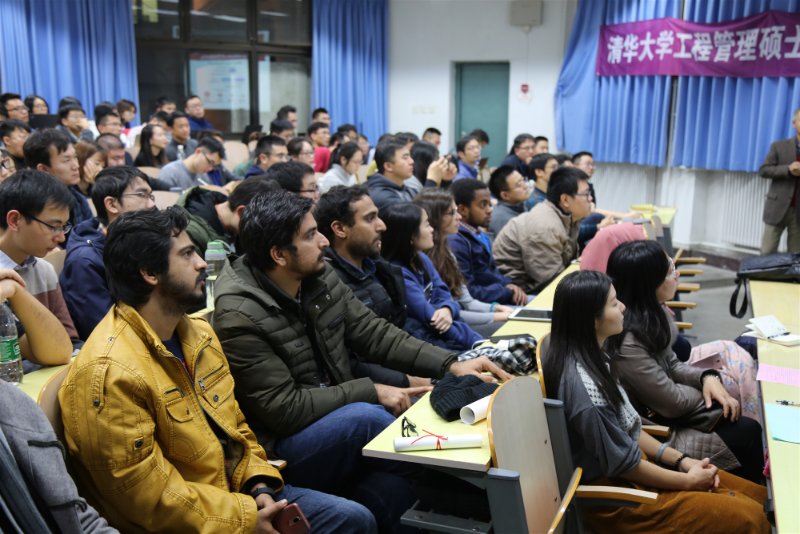
(IMEM students attend the lecture)
Professor Jim Browne, Member of Irish Academy and Irish Academy of Engineering highlights the challenges and opportunities regarding development of manufacturing industries in 21st century. He identifies the rapid growth of manufacturing technology and The Fourth Industrial Revolution and its effects on the whole world. Emerging technologies in 21st century such as digital manufacturing,virtual manufacturing, artificial intelligence, rapid prototyping, 3D-printing, industrial robotic evolution, data mining, big data analysis, green production, block-chain technology, automation,smart products & services with IoT etc. are going to enhance the production capacities of manufacturing industries to a large extent because the industry is transforming from manual to control system where industrial robots are going to work instead of humans. With artificial intelligence, it is more accuracy, less risk, fast pace and lower overall cost. The professor heralds with motivation that the scientist/researcher are working beyond the Industry 4.0 and planning to design what will come next to The Fourth Industrial Revolution.
The professor reiterated that this idea was not fully matured yet, and this is one of the challenge for researchers / scientist of todays. More scholars are needed to develop mechanism and system for this emerging technology. The world is now a global village. On time synchronizing with the modern technology has now become inevitable and even necessary to exist on the map of the world. This is what China is doing: preparing imminent generations for future world and to become a global leader.
Pakistan is an industrial country but lacking of modern technology and energy. But the good thing is that, more industrial zones are going to be established soon such as Gawadar Special Economic zone (SEZ) in Balochistan and various other dry ports all along the country. The SEZ’s are being built under China-Pakistan Economic Zones (CPEC). It is the best time for Pakistan and China to develop these industries with modern techniques of manufacturing technology as mentioned by Professor Jim Browne. Pakistan is lucky to have a good neighbor friend, China. This is food for thought for Pakistan to synchronize its industries with modern techniques and market strategies of the world. The professor further suggested Pakistani students during the lecture to motivate more scholars from Pakistan for research on modern manufacturing techniques, since highly qualified Industrial scientists and engineers would be needed to meet the needs for skilled persons. The young Pakistanistudents in the lecture are deeply impressed to transform this idea of the professor into reality and convey this message to other scholars/ researchers back to Pakistan.
——Khoso, Abdul Qadeer (Pakistan) IMEM2018
Other feedbacks from IMEM students
"The lecture delivered by Professor Jim Browne in topic of “Manufacturing in the 21st Century, Challenges and Opportunities” is an interesting and useful topic for applying on any industry. Especially Industry 4.0, a combination of the strengths of traditional industries with technologies enables to create SMART products through integrating multiple technologies that impact on production process and business process. Industry 4.0 causes changes in supply chain, business model and business process. For example, cloud computing and storage technology or blockchain is a famous topic in current world. Every day businesses exchange value with suppliers, partners, customers and others many times. In order to realize a successful, faster, more precise and easier-to-do transaction, blockchain is a technology applied to help in any businesses. Even in my country,Thailand, the government also promoted Thailand 4.0 as a new economic model aimed to push Thailand up in the high-income range. For Thailand 4.0, it focuses on creativity and innovation through applying in every industry such as shifting from traditional farming to be a smart farming, changing from unskilled labors to be knowledge workers, and changing from buying technologies to making technologies instead. Therefore, this lecture provided beneficial knowledge for IMEM students."
——Tanyalakmara, Thanrada (Thailand) IMEM2018
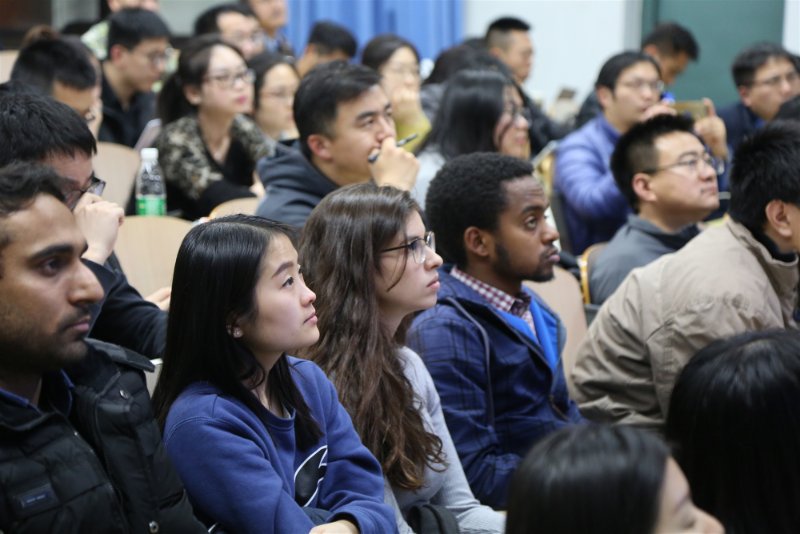
(IMEM students attend the lecture)
"I think that the lecture conducted by Mr. Jim Browne really covers the topic I am interested in.Because Industry 4.0 is a big thing and Indonesia are trying to shift toward the trend of Industry 4.0.In this lecture, we were taught on how to add value to the product and what kind of next generation products that is being expected by the people. This is also helpful in understanding the global business world that is becoming more and more complex. While in Indonesia, most of the business are still using the traditional way of doing business and even not having any business case to start a small medium enterprise. With the digital manufacturing knowledge, I want to help the small medium enterprise in my country to become better and to have a competitive advantage in the global world. The topic about beyond Industry 4.0 is also interesting and exciting, for example, the use of ant colony optimization in helping supply chain for manufacturer in Indonesia. Overall, it was a good seminar and it was very helpful in my mission to help the small medium enterprises in my country."
——Ricky, Albert (Indonesia) IMEM2018
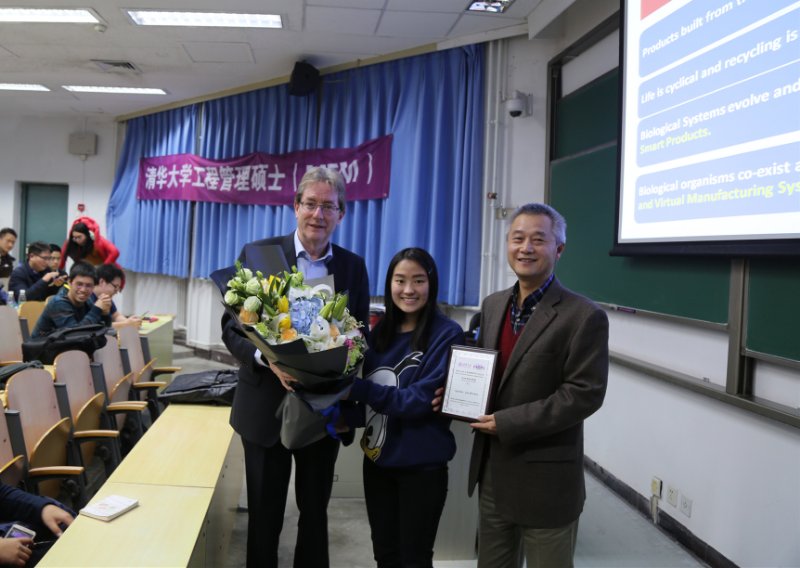
(Professor Jim Browne and Professor Ming Yu)
"A much needed shift towards a more knowledge-based, value added manufacturing is central to Brunei Vision 2035, a developmental framework of our nation, to diverse away from dependency on oil exports. Application of IT throughout the country is also a key component in this vision. Through its digitization effort and the widespread of IT mechanism, a greater sense of digital accountability can be imparted on industrial sectors in the country. This concept bodes well with the current reality of The Fourth Industrial Revolution, although Brunei will have unavoidable challenges ahead as digitization and manufacturing put together are two relatively new terms to the nation. Moving forward, enterprises should embrace and find value in circular manufacturing, rather than traditional manufacturing, as an opportunity to promote growth and accelerate innovation. During this period, as mentioned by the professor, we should be aware that the current job duties will change. Therefore, enterprises will not only require the well-educated but highly-skilled talents. With the right initiative and support, Brunei can absolutely integrate into this new era of industrialization."
——Alex Wui-Kiat Soon (Brunei) IMEM2017
"Manufacturing in Ethiopia was dominated by cottage and handicraft industries which met most of the population needs for manufactured goods such as clothes, ceramics, machine tools and leather goods before 1957. Industry sectors are booming in Ethiopia with a recent year’s big changes, from a traditional way of manufacturing to modern industrial manufacturing. Foreign enterprises are bringing their manufacturing technologies to the country. The Ethiopian government is encouraging manufacturing companies for circular manufacturing particularly plastics for environment protection.
From this lecture I have learned about the evolution of industry across the western countries, how smart products functioned in manufacturing industry and how circular manufacturing is implemented."
——G/tsadik, Nahom Gebremichael (Ethiopia) IMEM2018